What does a video podcast really cost in 2026?
The cost of a video podcast in the UK can range from £500 for a basic setup to over £8,000 for a professional studio. Whether you’re planning a DIY setup or exploring podcast studio hire, understanding the full video podcast budget, including equipment, production, and cost per episode, is essential for building a sustainable show.
I have helped founders, brand leads, and professional creators across London build video podcast setups at every budget level, and the question I am asked most consistently is not ” What camera should I buy?’ It is ‘what will this actually cost me to run every month?’ That is the right question. The setup cost is a one-time decision. Ongoing production cost is what determines whether your show survives past episode twelve.
In this guide, I break down every cost category in full, from video podcast equipment cost to post-production, editing software, hosting platforms, and professional studio hire in London, so you can build a video podcast budget that reflects what your show actually needs, not what a generic equipment list tells you to buy.
Video Podcast Equipment: What You Actually Need (and What It Costs)
Video podcast equipment cost is where most first-time creators overspend in the wrong areas and underspend in the ones that matter. The priority order for a video podcast is always audio first, then lighting, then camera. Poor audio makes content unwatchable. Weak lighting is manageable. But even an average camera delivers strong results when audio and lighting are done right far better than the reverse.
| Equipment Category | What to Know | UK Cost (2026) |
| Camera | Sony ZV-E10, Sony A7C, or Blackmagic Pocket for 4K video. Entry 1080p options from £300. | £300 – £2,500 |
| Microphone | Shure SM7B (dynamic, industry standard) or Rode PodMic for treated rooms. USB options for entry-level. | £80 – £400 |
| Audio Interface | Focusrite Scarlett Solo or 2i2 for XLR microphones. RODECaster Pro II for advanced multi-input setups. | £70 – £600 |
| Lighting Equipment | Key light, fill light, and background light. Elgato Key Light, Aputure, or Godox entry range. | £80 – £600 |
| Camera Lens | Fast prime lens (f/1.8) for background separation. A kit lens is acceptable at the entry level. | £100 – £800 |
| Teleprompter (optional) | Useful for scripted formats. iPad-based solutions work well. | £60 – £200 |
| Acoustic Treatment | Panels, bass traps. Critical for home environments. Affects audio quality more than microphone choice. | £80 – £500 |
| Memory Cards / Storage | Fast SD card for 4K capture. External SSD for editing storage. | £40 – £200 |
| Cables and Accessories | XLR cables, mic stands, camera mounts, and cable management. | £50 – £150 |
The single most common mistake in video podcast equipment purchasing is buying a 4K camera before investing in lighting. A Sony A7C shooting in a poorly lit room produces worse results than a mid-range camera with professional lighting equipment. Lighting determines the perceived quality of your video more than sensor resolution in almost every real-world recording environment I have assessed.
DIY Video Podcast Setups: Realistic Costs and Trade-Offs
A DIY video podcast budget covers the full setup you build, install, and manage yourself. For most London creators working from home or a home office, the realistic cost range sits between £500 and £1,800, depending on the quality tier.
Entry-Level DIY Video Podcast Budget (£500 – £900)
- Camera Sony ZV-1 or similar 1080p compact camera: £350 – £500
- Microphone Rode NT-USB Mini or Blue Yeti USB: £80 – £130
- Lighting equipment Single Elgato Key Light or equivalent: £80 – £120
- Acoustic treatment Basic foam panel kit: £60 – £100
- Editing software DaVinci Resolve (free) or Descript: £0 – £25/month
- Hosting platform Buzzsprout or Transistor: £12 – £29/month
- Total one-time setup: £570 – £850
Mid-Range DIY Video Podcast Budget (£1,200 – £1,800)
- Camera Sony ZV-E10 with fast prime lens for background separation: £700 – £950
- Microphone Shure SM7B, the industry standard dynamic microphone: £350 – £400
- Audio interface Focusrite Scarlett Solo or 2i2: £80 – £130
- Lighting equipment: Two-light setup, key and fill: £160 – £300
- Acoustic treatment Professional panel kit with bass traps: £150 – £300
- Editing software Adobe Premiere Pro or Final Cut Pro: £55/month or £300 one-time
- Hosting platform Transistor or Buzzsprout advanced plan: £19 – £49/month
- Total one-time setup: £1,440 – £1,880
At the mid-range level, the Shure SM7B paired with a Focusrite Scarlett interface represents the most reliable audio foundation for a home video podcast. It is the same microphone used in professional broadcast environments, and its rejection of background noise makes it particularly well-suited to London home and office recordings where complete acoustic isolation is not achievable.
What the budget numbers above do not show is the time cost. Managing your own DIY vs professional setup means three to six hours of post-production per episode in the early months, plus ongoing troubleshooting as your setup evolves. For creators running a business alongside their podcast, this is where the DIY model most often breaks down, not because of budget, but because of time.
Done-For-You Video Podcast Studios: Cost, Setup, and Long-Term Value
A done-for-you video podcast studio is a professionally designed, installed, and configured recording environment built inside your home or office. Every component, camera positioning, lighting equipment, acoustic treatment, audio interface configuration, and editing workflow, is selected and set up by a specialist. You walk in, record, and leave the rest to your production team.
What a Done-For-You Video Studio Installation Includes
- Full acoustic assessment of your recording space and professional treatment applied
- Camera selection and positioning for your format: single host, multi-guest, or multi-camera setup
- Lighting equipment installed and calibrated, key, fill, and background lighting configured for your specific room
- Microphone and audio interface selected and matched to your room acoustics and recording format
- RODECaster Pro II or equivalent multi-channel interface setup for guest-format shows
- Post-production workflow configured video editing, colour grading, audio mastering, and platform delivery
- Ongoing post-production retainer handling every episode from raw recording to published output
- Studio installation (audio only) Acoustic treatment, microphone, interface, DAW setup: £2,000 – £4,000
- Studio installation (video + audio) Full camera, lighting, acoustic, and audio configuration: £3,500 – £8,000
- Monthly post-production retainer: Editing, mastering, show notes, distribution: £300 – £800/month
Equipment upgrade support, Ongoing assessment and upgrade management: included in retainer
The done-for-you model delivers the most efficient cost-per-episode outcome over a 12-month horizon for creators publishing weekly. When you factor in the time cost of DIY post-production, conservatively valued at three hours per episode at a professional’s hourly rate, the done-for-you retainer model consistently outperforms DIY on a total cost basis by month six or seven.
Professional Video Podcast Studio Hire in London: Pricing and What You Get
Professional studio hire in London removes every equipment variable from the equation. You arrive at a fully configured video podcast studio with a multi-camera setup, calibrated lighting equipment, and broadcast-grade audio, and record without managing a single technical element. For founders, executives, and brand teams who value their time at a meaningful hourly rate, this is often the most cost-efficient model available.
London’s professional podcast studio market has matured significantly since 2022. Purpose-built video podcast studios now operate across Soho, Shoreditch, Borough, and King’s Cross, offering multi-camera setup configurations, 4K video recording, broadcast-quality lighting, and in-house post-production packages.
What a London Video Podcast Studio Session Includes
- A multi-camera setup typically has two to four cameras covering host, guest, and wide shots simultaneously
- 4K video recording with professional colour grading applied in post-production
- Broadcast-grade lighting equipment key, fill, backlight, and background configured for each session
- Acoustic treatment room with broadcast-level noise floor, no environmental interference
- On-site audio engineer managing levels, monitoring, and session capture throughout
- In-house post-production video edit, colour grade, audio master, and platform-optimised delivery
- Short-form clip extraction for LinkedIn, YouTube Shorts, and Instagram Reels is standard in most packages
Video Podcast Studio Hire Costs in London 2026 Pricing
- Audio-only studio hire (treated room, engineer): £80 – £150/hour
- Video podcast studio hire (multi-camera, 4K, lighting, engineer): £150 – £350/hour
- Half-day package 4 hours, batch recording 3 to 5 episodes: £500 – £900
- Full-day production package (recording, editing, colour grading, delivery): £800 – £1,800/day
- Monthly retainer with studio access and post-production included: £1,200 – £3,500/month
- Video clip package add-on social media clips per episode: £150 – £400/episode
The professional studio hire model is most cost-effective for creators publishing fortnightly or monthly, or for brands that need high-quality episodic content without committing to a permanent studio installation. Batch recording, capturing three to five episodes in a half-day session, reduces the per-episode cost of studio hire significantly and is the approach I recommend to most London clients working within a defined video podcast budget.
The Ongoing Cost of Running a Video Podcast
Setup costs get most of the attention, but ongoing costs determine whether a video podcast is financially sustainable at scale. I track five categories of ongoing costs for every show I work with, and most creators underestimate at least three of them before launch.
- Post-production (video editing), video edit, colour grade, audio master per episode: £200 – £600/episode
- Audio mastering to -16 LUFS integrated for platform compliance, included in most retainers: £30 – £80/episode
- Hosting platform RSS feed, analytics, distribution to Apple Podcasts, Spotify, YouTube: £12 – £49/month
- Editing software Adobe Premiere Pro, Final Cut Pro, or DaVinci Resolve: £0 – £55/month
- Thumbnail and graphics episode artwork and social media templates: £30 – £150/episode
- Show notes and SEO copy written summary, timestamps, optimised description: £50 – £150/episode
- Short-form clip editing LinkedIn, Instagram Reels, YouTube Shorts: £80 – £250/episode
- Studio hire ongoing per-session or monthly retainer: £150 – £3,500/month
The most important ongoing cost calculation is cost-per-episode at your target publishing frequency. A weekly video podcast with full post-production outsourced in London typically runs at a total ongoing cost of £600-£1,400 per episode. A fortnightly show with batch recording and an in-house editor can run significantly lower. Understanding this number before you launch is the difference between a content strategy and a content experiment.
DIY vs Professional: Choosing the Right Video Podcast Model
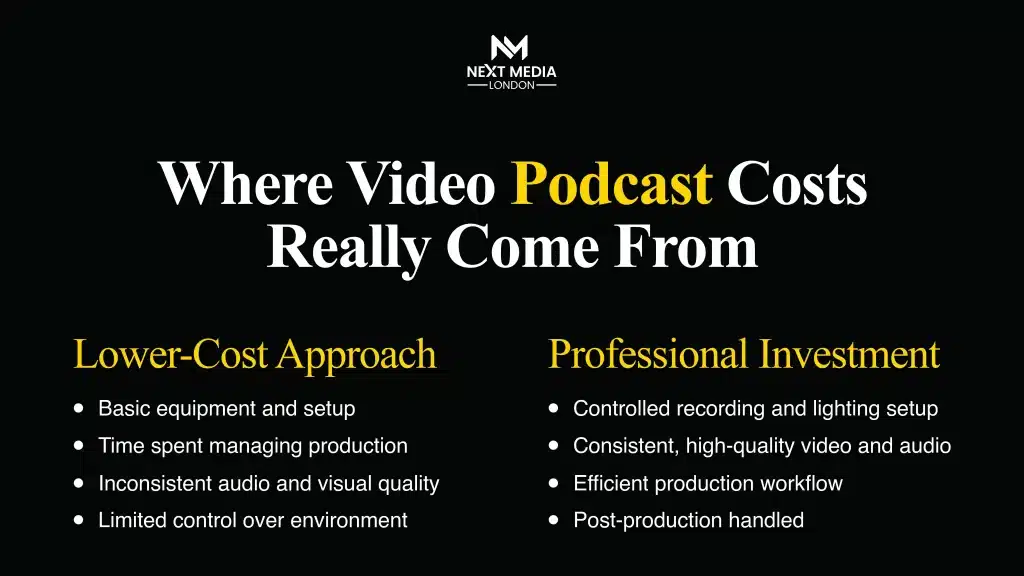
The DIY vs professional decision is not primarily a budget decision; it is a time and consistency decision. Both models can produce excellent video podcast content. The difference is in who carries the production burden and how that burden affects your publishing cadence over time.
- DIY Home Setup: £500–£1,800. Ongoing: £50–£100/month plus your time. Time investment: 3–6 hours per episode. Quality ceiling: good with developed skills. Best for early-stage creators.
- Done-For-You Studio Setup: £2,500–£8,000. Ongoing: £300–£800/month retainer. Time investment: near zero, fully handled. Quality: broadcast standard. Best for serious, consistent creators.
- Professional Studio Hire Setup: £0, session-based. Ongoing: £150–£350/hour. Time investment: minimal, in-studio only. Quality: broadcast standard. Best for high-profile or video-led brands.
Common Video Podcast Budget Mistakes to Avoid
- Prioritising the camera over lighting equipment, lighting determines visual quality more than any other single variable in a home recording environment
- Purchasing a condenser microphone for an untreated room, an acoustic treatment investment delivers more audio improvement per pound than any microphone upgrade in a reflective space
- Ignoring the RODECaster Pro II or similar multi-input interface for guest formats, a single audio interface that cannot handle two simultaneous inputs creates unfixable production problems
- Underestimating post-production cost, video editing is two to three times more time-intensive than audio-only editing, and this cost compounds at a weekly publishing frequency
- Launching without a hosting platform configured for video, not all podcast hosting platforms support video podcast distribution to YouTube and all major directories simultaneously
- Building a 4K multi-camera setup without an editor who can handle 4K footage, raw 4K files require significant processing power and storage infrastructure that entry-level editing setups cannot manage reliably
Measuring ROI: Is Your Video Podcast Worth the Investment?
- Episode Completion Rate (video) above 50% on YouTube is strong, above 40% for episodes over 30 minutes. Track in YouTube Studio.
- Average View Duration target above 35–40% of total episode length on YouTube. This is the most reliable indicator of content quality.
- Audio Completion Rate above 65% on Spotify and Apple Podcasts, tracking your audio audience separately from video. Source: Spotify for Podcasters.
- 30-Day Download and View: Total combined audio downloads and YouTube views. 200+ in 30 days places a show in the top 40% globally.
- Clip Performance Rate: short-form clip views versus full episode views. Target 3–5x amplification to measure distribution efficiency.
- Cost Per Episode: Published total monthly production cost divided by episodes published. Track this monthly without exception.
Cost Per Episode Formula
| Cost Per Episode = (Monthly Setup Amortisation + Monthly Ongoing Costs) ÷ Episodes Published Per Month Example: £4,000 studio installation amortised over 24 months (£167/month) + £500 post-production retainer = £667/month. Publishing 4 episodes per month = £167 cost per episode.Target: Under £200 per episode for a self-funded creator. Under £400 for a brand-funded show. |
A Six-Step Framework for Building a Sustainable Video Podcast Budget
- Define your format first: solo, interview, or multi-guest. Format determines whether you need a multi-camera setup, how many audio inputs your interface requires, and what your post-production complexity will be.
- Set your publishing frequency: Weekly, fortnightly, or monthly. Frequency determines your ongoing cost commitment more than setup cost. Confirm you can sustain it before investing in infrastructure.
- Choose your production model: DIY for early-stage exploration, done-for-you installation for consistent weekly output, or professional studio hire for high-quality episodic content without permanent infrastructure.
- Build your equipment stack in priority order: Acoustic treatment first, microphone second, lighting equipment third, camera fourth. Never reverse this sequence.
- Calculate your cost per episode before launching. Use the formula above. If the number is unsustainable at your target frequency, adjust the model before you invest.
- Configure distribution from day one: hosting platform, RSS feed, YouTube channel, and all major audio directories active before your first episode publishes.
Video Podcast Pre-Launch Cost Checklist
- Total setup budget confirmed and allocated across equipment categories in priority order
- Monthly ongoing cost calculated for post-production, hosting platform, editing software, and graphics
- Cost per episode calculated at target publishing frequency
- Acoustic treatment is applied before any recording begins, not after
- Shure SM7B or equivalent dynamic microphone paired with Focusrite Scarlett interface, tested and level-checked
- Lighting equipment is positioned and colour temperature calibrated before camera placement is finalised
- Camera framing, focus, and exposure locked for your recording position
- Post-production workflow assigned internal editor or external retainer confirmed before episode one
- Hosting platform live, RSS feed active, YouTube channel configured
- The first three episodes were recorded before episode one was published
Why the Camera Is Never the Real Cost
Every video podcast conversation I have with London creators starts in the same place. They want to know which camera to buy. They have researched the Sony A7C, they know what 4K means, and they have a number in mind. My first question is always: what does your room sound like? And the second is: what does your lighting look like right now?
The camera is the least important variable in a video podcast setup. It is also the most visible line item in a video podcast budget, which is why it receives disproportionate attention. A £300 camera in a properly treated room with professional lighting equipment will consistently outperform a £2,500 camera in a reflective, poorly lit space, and that gap grows every time you publish.
The creators I see build durable, growing video podcasts in London are not the ones who spent the most on cameras. They are the ones who solved their room first, locked in a production system that held under the pressure of weekly publishing, and treated their podcast infrastructure as a long-term investment rather than a launch-day purchase.
| If you are at the stage where your video podcast is a serious content investment, not a trial, the setup you build and the production system behind it will determine how far it goes. At Next Media London, we design and install video podcast setups and production systems built for consistent, long-term output, not just launch. If you want to build your podcast properly from day one, find out what a tailored setup could look like at NextMedia.london. |
Conclusion
Video podcasting in London has never been more accessible, but that does not mean it is simple. The creators who build shows that last are not the ones who spent the most on cameras; they are the ones who solved their room, locked in a production system, and calculated their cost per episode before recording episode one. Choose the model that fits your time, not just your budget. A DIY setup costs less upfront and more in hours. A done-for-you studio costs more upfront and returns that investment in consistency. A professional studio hire costs nothing until you need it and delivers broadcast quality every session. Run the cost-per-episode formula. Pick the model that holds under weekly publishing pressure. Then build it properly from the start because the shows that compound in value are never the ones that launched with the best equipment. They are the ones who never stopped publishing. If you are ready to build a video podcast setup that performs consistently over time, Next Media London installs done-for-you studios and operates a professional video podcast studio in London built for exactly that. Find out more at nextmedia.london.
Frequently Asked Questions (FAQS)
How much does it cost to start a video podcast in the UK?
A basic DIY setup runs £500–£900. A professionally installed done-for-you studio costs £2,500–£8,000, and professional studio hire in London sits between £150 and £350 per hour.
What is the cheapest way to start a video podcast?
A USB microphone, a single key light, and a 1080p camera get you started for under £600. The real saving is acoustic treatment; a treated room improves audio quality more than any equipment upgrade at this budget level.
Do I need a 4K camera for a video podcast?
No 1080p footage with professional lighting consistently outperforms 4K footage in a poorly lit room. Invest in lighting equipment before upgrading your camera sensor resolution.
How much does video podcast editing cost in the UK?
Professional video editing per episode runs £200–£600, depending on length and complexity. A monthly post-production retainer covering editing, audio mastering, and distribution typically costs £300–£800 in London.
What microphone do most professional video podcasters use?
The Shure SM7B is the industry standard for video podcasting, used in broadcast environments globally and priced at £350–£400 in the UK. It requires an audio interface such as the Focusrite Scarlett Solo to operate.
Is it worth hiring a podcast studio in London instead of recording at home?
Yes, if you value your time or need broadcast-quality output without managing infrastructure. Studio hire removes every technical variable and is the most efficient model for founders and brand teams recording fortnightly or monthly.
How long does it take to edit a video podcast episode?
A 45-minute episode takes three to six hours to edit in the early months of DIY production. With an experienced editor or done-for-you retainer, turnaround reduces to 24–48 hours from raw recording to published output.