
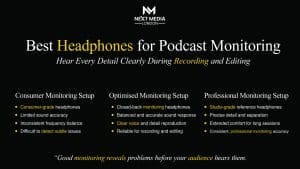
What Are the Best Podcast Monitoring Headphones in 2026?
The best headphones for podcast monitoring in 2026 are closed-back, over-ear studio models with a flat frequency response, impedance between 32–80 ohms, and strong passive isolation. Trusted professional choices include the Sony MDR-7506, Audio-Technica ATH-M50x, Beyerdynamic DT 770 Pro, Sennheiser HD 280 Pro, and Rode NTH-100, all proven across studio environments and home setups in the UK and beyond.
I learned this the hard way. I spent three months recording what I believed were clean, balanced podcast episodes until I sat down with a proper pair of studio monitoring headphones and heard the truth. Every episode had a low-frequency room rumble I had completely missed. That mistake cost me re-recordings, re-edits, and a sizable portion of my patience. The right headphones are not an optional upgrade in podcasting. They are your quality control system.
Whether you’re producing solo commentary, running a multi-guest interview format, or editing a serialised audio documentary, the monitoring headphones you wear during recording and post-production will determine whether problems get caught before your audience hears them or after. In this guide, I’m covering exactly what to look for, which models I genuinely trust in 2026, and how to build a monitoring setup that holds up across long production days. If you’re still building your full recording setup, including microphones, cameras, lighting, and studio acoustics, start with our complete Podcast Recording Guide 2026.
What Is Podcast Monitoring and Why Does It Matter?
Podcast monitoring refers to the practice of listening to your audio in real time, either during recording or critically during the editing process, to identify and correct problems before they reach your audience. A monitoring headphone is engineered to reproduce audio as accurately and neutrally as possible, without adding bass warmth, boosting presence artificially, or flattering any part of the frequency spectrum. In professional audio, this is called a flat frequency response.
When I monitor a recording session, I’m listening for breath noise between sentences, plosive bursts on B and P sounds, background air conditioning hum, mic handling vibration, and room reflections that muddy the low midrange. None of these is obvious through consumer headphones or earbuds. A proper monitoring headphone surfaces every flaw with clinical precision, and that is the entire point. If your headphones are making your audio sound better than it actually is, they are actively working against you.
What to Look for in Podcast Monitoring Headphones
There are five technical specifications I evaluate before recommending any headphone for podcast use. Understanding them removes most of the guesswork from the purchase decision.
Frequency Response
Look for a published frequency response as close to 20Hz–20kHz flat as possible. A slight presence boost at 3–5kHz is acceptable and can actually help with voice clarity monitoring. What you want to avoid is any headphone that adds meaningful bass lift below 200Hz or excessive air above 10kHz, both signatures of consumer-tuned headphones that will mask real problems in your recordings.
Impedance
Consumer headphones typically run at 16–32 ohms. Studio monitoring headphones range from 32 to 250 ohms. For podcast setups using common interfaces such as the Focusrite Scarlett 2i2, Rodecaster Pro II, or SSL 2+, anything between 32–80 ohms is the practical sweet spot. A 250-ohm headphone plugged directly into a laptop headphone jack will sound thin, quiet, and unreliable. Always match impedance to your output source.
Driver Size
A 40mm driver is the standard minimum for studio use. Larger 45–50mm drivers offer better low-frequency accuracy, which becomes important when you need to hear proximity effect buildups from dynamic microphones or check for subtle room rumble. Driver size alone does not determine sound quality; it’s one factor within a complete engineering picture, but it is worth paying attention to when comparing similarly priced models.
Build Quality and Repairability
Podcasters wear headphones for two to four hours at a stretch, often daily. Swappable ear pads, detachable cables, and folding headbands are not luxury features — they are the difference between a headphone that lasts two years and one that lasts a decade. I would not recommend any professional monitoring headphone in 2026 that does not offer readily available replacement ear pads.
Closed-Back vs Open-Back Headphones for Podcasting
This is the most common technical question I receive from new podcasters, and the answer is relatively straightforward: use closed-back headphones for recording, and open-back headphones for editing if your budget allows for both.
Closed-back headphones seal the ear cups completely against the head, preventing audio bleed from the headphone drivers into your microphone. This matters enormously during recording. If you monitor through open-back headphones while a microphone is live, the ambient audio from your headphones becomes a permanent part of your recording. In professional podcast studios across London, closed-back models are the non-negotiable standard for in-booth use.
Open-back headphones allow air to pass through the driver housing, creating a wider and more accurate soundstage. Models like the Sennheiser HD 600 are exceptional for mixing and editing, but completely unsuitable for recording. For most podcasters who handle both recording and post-production, I recommend beginning with a quality closed-back model. It covers both use cases adequately, even if it is not the absolute best tool for editing-only work.
If you want to hear how professional monitoring changes your recording quality in real time, book a session at our London podcast studio.
Best Studio Headphones for Podcast Monitoring in 2026
The following table covers the five models I consistently recommend to podcasters in the UK. Pricing reflects typical retail costs in GBP at the time of writing, including from UK suppliers such as Thomann UK and Andertons.
| Model | Type | Impedance | Driver | Best For | UK Price |
| Sony MDR-7506 | Closed-Back | 63Ω | 40mm | All-round use | £85–£100 |
| AT ATH-M50x | Closed-Back | 38Ω | 45mm | Recording + Editing | £120–£150 |
| Beyerdynamic DT 770 Pro | Closed-Back | 80Ω | 45mm | Studio isolation | £130–£160 |
| Sennheiser HD 280 Pro | Closed-Back | 64Ω | 40mm | Budget professional | £70–£90 |
| Rode NTH-100 | Closed-Back | 64Ω | 40mm | Podcast-specific | £100–£130 |
The Sony MDR-7506 remains the industry workhorse for a reason. It has been the standard for monitoring in broadcast and podcast studios since the 1990s. Its slightly forward midrange is ideal for voice monitoring, the build is lightweight, and the coiled cable is rugged enough for daily professional use. Under £100, this is still my first recommendation for UK podcasters building a lean setup.
The Audio-Technica ATH-M50x delivers greater low-end clarity than the MDR-7506, making it better suited to music podcasts or episodes where guests play instruments in the room. The swappable cable system is a genuine professional feature. Replaceable 3m straight, 3m coiled, and 1.2m short cables are all included in the box.
The Beyerdynamic DT 770 Pro at 80 ohms is where I personally land. The bass extension is accurate without being exaggerated, passive isolation is excellent, and the build quality suggests something that will still be performing a decade from now. I have used mine across multiple studio sessions in London on different interfaces without a single complaint.
The Sennheiser HD 280 Pro is the reliable entry point for podcasters working on a tighter budget. Its passive noise isolation, rated at up to 32dB, is among the strongest in its price class, which makes it especially valuable in home studios without acoustic treatment.
The Rode NTH-100 was designed specifically for content creators and reflects that intentionality. It includes an inline level control on the coiled cable, the sound signature is slightly warmer than the MDR-7506 but still monitoring-grade, and the fit system is genuinely comfortable for extended sessions. Want to test professional monitoring setups before investing in gear? Record your next episode in our fully equipped London podcast studio.
How to Test If Your Headphones Are Good for Podcast Editing
There are two practical tests I run with any headphone before trusting it for professional work.
The first is the breath noise check. Record a 30-second segment where you breathe naturally between sentences without editing or noise reduction applied. Play it back at normal listening volume. If your headphones reveal the subtle detail of breath sounds between words, they are resolving enough for monitoring work. If the audio sounds unusually clean and smooth, more than your raw recording should sound, the headphones are masking the detail you need to hear.
The second is the room noise floor check. Record 10 seconds of pure silence in your recording environment with your microphone live. Play it back loudly through your headphones. A proper monitoring headphone will surface hiss, HVAC hum, electrical interference, or room reverb that budget headphones would obscure. If your silence sounds genuinely silent, either your room is extraordinarily well treated, or your headphones are hiding problems you will discover only after publishing.
What Makes Headphones Comfortable for Long Podcast Sessions?
Comfort becomes a production variable that most new podcasters underestimate until they have worn a poorly designed headphone for three hours. There are four factors I evaluate for long-session comfort.
- Clamping Force: The headphone must stay on your head securely, but excessive pressure on the temples causes pain within 45 to 60 minutes. The ideal clamping force is firm without feeling tight.
- Ear Pad Material Memory foam pads with protein leather or velour covering are the most comfortable for extended use. Pure PU leather pads trap heat aggressively, tolerable for 30 minutes, genuinely unpleasant at the two-hour mark.
- Weight Distribution: A well-balanced headphone distributes its mass evenly across the headband arc. The ATH-M50x is slightly front-heavy by comparison to the DT 770 Pro, a difference many users notice across longer sessions.
- Replaceability: For any serious podcast setup, I only recommend headphones with readily available replacement ear pads. Pads compress and degrade over time. Replacing them extends the operational life of a headphone from roughly two years to potentially a decade.
Where to Buy Podcast Monitoring Headphones in the UK
If you’re based in London or anywhere across the UK, you have better purchase options than generic online retail. Thomann UK ships quickly, prices competitively, and carries the full range of professional monitoring headphones covered in this guide. Andertons in Guildford offers an in-store demo experience that I genuinely value. Hearing the acoustic difference between a Sony MDR-7506 and a Beyerdynamic DT 770 Pro on your own ears, in person, before committing to a purchase, is worth the visit.
For London-based podcasters booking time in professional podcast studios, particularly in Bermondsey, Shoreditch, or Soho, many studios supply standard closed-back monitoring headphones as part of their included session equipment. Using those studio sessions as an opportunity to audition different models before purchasing your own is an intelligent and underused strategy.
Common Mistakes Podcasters Make When Buying Headphones
- Buying consumer headphones and treating them as studio tools. Beats Studio, Bose QuietComfort, and Sony WH-1000XM-series headphones are excellent consumer products. They are not monitoring instruments. Their frequency responses are engineered to make music enjoyable, not accurate. Using them to edit a podcast is equivalent to colour-grading video on an uncalibrated screen.
- Ignoring impedance matching. A 250-ohm headphone connected directly to a laptop headphone jack will sound thin, quiet, and unreliable. Always verify that your recording interface or headphone amplifier can drive your chosen headphone’s impedance correctly.
- Prioritising portability over acoustic accuracy. On-ear and in-ear monitor designs are convenient. Over-ear closed-back headphones remain the professional standard for podcast monitoring because their acoustic seal and driver size simply cannot be replicated in a smaller form factor.
- Purchasing once and never replacing ear pads. Degraded pads break the acoustic seal and directly alter the headphone’s frequency response. A £150 headphone with two-year-old flattened pads will perform worse than an £80 headphone with fresh pads installed.
- Choosing headphones without testing them with voice content. Many podcasters test headphones with music during purchase. Voice reproduction is different; midrange clarity, breath detail, and sibilance handling matter far more than bass extension when your content is conversational audio.
The Future of Podcast Monitoring Headphones
Two developments are shaping the headphone monitoring landscape heading into the latter half of 2026 and beyond.
The first is AI-assisted frequency calibration. Tools like Sonarworks SoundID Reference are enabling headphone-based monitoring environments where the software measures individual headphone response curves and applies real-time EQ correction to deliver reference-flat playback regardless of the headphone’s hardware characteristics. This technology is maturing quickly. The Sennheiser HD 490 Pro was designed from the ground up with SoundID integration in mind, and similar collaborative developments are expected across other major manufacturers.
The second is low-latency wireless monitoring. Bluetooth LE Audio, introduced under the Auracast framework, is pushing monitoring-capable wireless headphone latency below 20 milliseconds for the first time, approaching the threshold where wireless becomes genuinely viable for live podcast recording self-monitoring. As of 2026, wired closed-back headphones remain the professional standard, but the gap is narrowing in a way that was not measurable two years ago.
For UK podcasters specifically, the shift toward hybrid and remote podcast production is driving demand for headphones that perform equally well in home setups and professional London studios, pushing manufacturers toward more versatile, interface-agnostic designs with broader impedance compatibility.
How to Choose the Right Podcast Monitoring Headphones
Use this framework to evaluate any headphone before committing to a purchase:
- Confirm headphone type: closed-back for recording, open-back for editing-only use.
- Match impedance to your interface output target 32–80 ohms for most podcast setups.
- Verify driver size: 40mm minimum, 45mm preferred for low-frequency accuracy.
- Check the ear pad material and confirm replacement pads are commercially available.
- Run the breath noise check and room noise floor check with your actual microphone.
- Test the headphone’s clamping force for at least 30 minutes before purchasing, if possible.
- Purchase from a UK supplier with a return policy, as monitoring headphones are personal and acoustic preference matters.
- Plan for ear pad replacement every 18–24 months of regular use.
Podcast Headphone Setup Checklist
- Select a closed-back, over-ear monitoring headphone from the recommended models above.
- Confirm impedance compatibility with your recording interface or headphone amplifier.
- Run the two audio quality tests (breath noise check and room noise floor check) within your first week of use.
- Set a reminder to inspect the ear pad condition every six months.
- Source replacement ear pads for your chosen model before the originals degrade.
- If editing in a separate session from recording, consider an open-back headphone for the editing stage.
- If based in London, book time in a professional podcast studio to audition multiple models before finalising your purchase decision.
Why Professional Monitoring Headphones Improve Podcast Quality
The strategic advantage of investing in proper podcast monitoring headphones is not about sound quality as an end goal, but rather error detection speed. A podcaster using monitoring-grade headphones catches problems during or immediately after recording, when correction is simple and fast. A podcaster using consumer headphones discovers the same problems during editing or after publishing, when the cost in time, effort, and audience trust is significantly higher. Every pound spent on accurate monitoring headphones reduces the cumulative cost of poor audio decisions across an entire production run. In the UK podcast market, where audience expectations for audio quality have risen sharply since 2022, that cost reduction compounds in your favour with every episode you produce.
Whether you’re launching your first podcast or upgrading an established production, hearing your audio accurately changes everything. Book a session at NextMedia London and experience professional podcast monitoring in a fully treated recording environment.
Conclusion
Throughout my years of recording in various environments, I’ve learned that my headphones are my most critical diagnostic tool. I used to think any “good” pair would work, but a single session ruined by missed low-frequency rumble taught me the truth. Even in 2026, I still reach for wired staples like the MDR-7506 or DT 770 Pro because they refuse to sugarcoat what they hear. These tools don’t just help me enjoy the audio; they help me see the clicks, the background hum, and the harsh sibilance. I view a flat frequency response as a non-negotiable requirement for anyone who cares about broadcast-grade quality. Investing in reference-grade hardware has consistently saved me from the nightmare of re-recording a ruined interview. My final advice is to stop looking for headphones that sound “pretty” and start looking for the ones that tell you the truth. Ultimately, your voice is your brand, and these headphones are the clinical guardians of that reputation every single session.
Frequently Asked Questions (FAQS)
Q: Can I use wireless Bluetooth headphones for podcast recording in 2026?
Wired is standard for zero lag, though Bluetooth LE Audio now offers sub-40ms latency for mobile setups.
Q: Should I choose closed-back or open-back headphones for my podcast?
Use closed-back for recording to prevent mic bleed, but switch to open-back for editing’s natural soundstage.
Q: Are consumer noise-canceling headphones like the Sony XM6 good for editing?
A: No, consumer models color sound too much; professional monitors are required to hear the unfiltered truth.
Q: What impedance (ohms) should my podcasting headphones have?
Aim for 32 to 80 ohms for most interfaces; 250-ohm models often require a dedicated amplifier.
Q: How does Auracast technology help in a multi-guest podcast setup?
Auracast allows one interface to broadcast high-quality audio to multiple receivers at once without individual pairing.
Q: Why is it important to replace headphone ear pads every 18 months?
Compressed or flaking pads break the acoustic seal, which directly degrades frequency response and monitoring accuracy.