
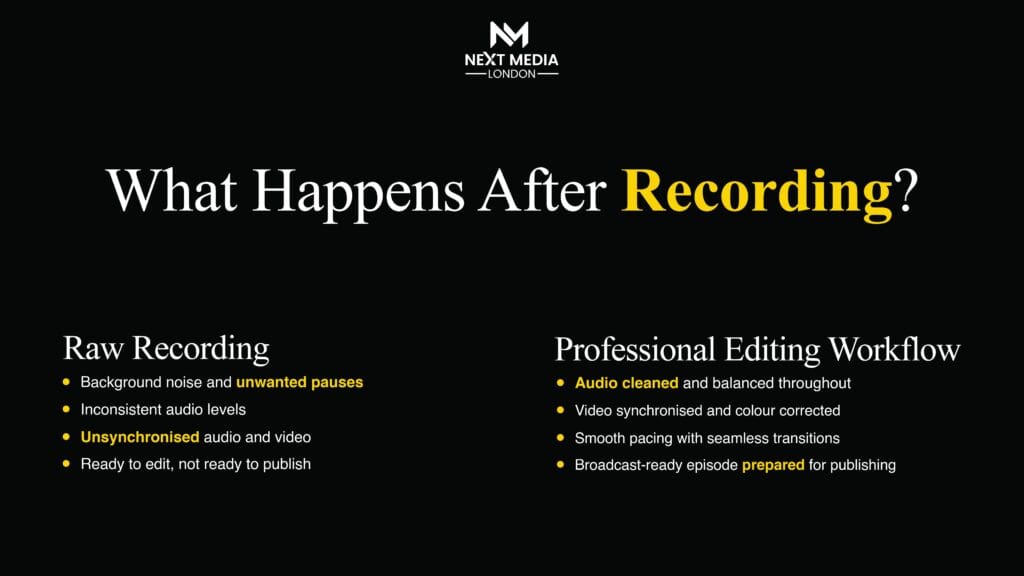
Recording is only one stage of producing a professional podcast. Once the microphones are switched off, the raw recordings need to be edited, mixed, mastered, and prepared for distribution. Video podcasts may also require camera synchronisation, colour correction, captions and short-form content for social media.
At NextMedia London, we understand that a successful podcast depends on more than a good recording. A structured post-production workflow helps us maintain consistent quality, reduce production delays and prepare each episode for its intended audience. For businesses, founders, and independent creators, it also creates opportunities to turn a single recording into multiple pieces of content.
In 2026, video podcasts and content repurposing remain important considerations for modern podcast production. We believe that understanding the post-production process helps creators make better decisions about recording, editing, and publishing their content.
The Podcast Post-Production Process, Step by Step
Post-production follows roughly the same six stages in every professional workflow, whether you edit in-house or outsource it completely.
1. Ingest and Organise Your Files
Raw audio and video get pulled from your recorder or cloud storage and organised into a consistent folder structure. Skipping this step is the single biggest cause of delays once a show scales past a handful of episodes.
2. Structural Edit (Cut and Arrange)
This is where the episode’s shape gets decided: what stays, what goes, and in what order. Editors remove false starts, off-topic tangents, and dead air, then reorder sections so the strongest moment lands early enough to hook a listener.
3. Audio Editing and Cleanup
Filler words, mouth clicks, background noise, and long pauses get cleaned up here. The goal isn’t a sterile recording; natural pauses and personality should survive the edit, just the distractions that make listeners stop.
4. Mixing
Mixing balances the individual tracks against each other: levelling a quiet guest against a loud host, applying EQ so each voice sounds clear, and adding compression so listeners aren’t constantly reaching for the volume dial.
5. Mastering
Mastering treats the finished mix as a single file, applying a limiter and adjusting overall loudness to platform standards, typically around -16 LUFS for Apple Podcasts, with Spotify and YouTube closer to -14 LUFS.
6. Show Notes, Metadata and Publishing
The final stage covers everything that helps an episode get found: show notes, timestamps, episode artwork, metadata tags, and uploading to your hosting platform for distribution to Apple Podcasts, Spotify, and YouTube.
Podcast Mixing vs Mastering: What’s the Difference?
Mixing and mastering get used interchangeably, but they’re different jobs. Mixing works on individual tracks and how they sit together; mastering works on the finished stereo file and prepares it for distribution.
| Mixing | Mastering | |
| Works on | Individual tracks (host, guest, music) | The final combined file |
| Main tools | EQ, compression, level balancing | Limiting, loudness normalisation |
| Goal | Every voice sounds clear and balanced | Consistent loudness across platforms |
| Happens | Before mastering | After mixing, as the last technical step |
For most podcasts, both happen in the same session, but knowing the difference helps you brief an editor accurately, or judge the quality of a professional podcast editing service before you hire one.
DIY Podcast Editing vs Hiring a Professional
DIY editing costs nothing but your time; expect two to five minutes of editing for every one minute of finished audio. Hiring a professional costs money but frees up that time and tends to deliver more consistent results episode after episode.
| DIY | Freelance Editor | Professional Agency | |
| Cost | Free (your time) | £60–£250 per episode | £400–£900 per episode |
| Time investment | 2–5 hrs per episode | Minimal (review only) | Minimal (review only) |
| Consistency | Varies with skill and energy | Good | Very high |
| Best for | Solo or hobby shows | Growing shows | Branded or sponsored podcasts |
Neither option is wrong. It comes down to what your time is worth against the cost of outsourcing your podcast editing, and how consistent your show needs to sound for listeners or sponsors.
Turnaround time depends on episode length, recording quality, the number of audio and video tracks, editing complexity and the number of requested revisions.
A straightforward audio episode may require substantially less work than a multi-camera video podcast with captions, branded graphics and social clips. A repeatable workflow can reduce avoidable delays, but quality checks and approval stages still need sufficient time.
For recurring podcasts, we recommend agreeing on file-delivery formats, revision limits and publishing deadlines before production begins.
At NextMedia London, we offer different levels of studio and editing support to accommodate different production requirements. Our podcast studio hire service includes options for recording sessions with technical assistance and additional post-production support.
AI in the Podcast Editing Workflow: What’s Changed
AI hasn’t replaced podcast editors; it’s replaced the slowest parts of their job. Text-based editing now lets editors cut audio by deleting words in a transcript, and AI-assisted cleanup handles noise reduction and level-balancing in a single click.
The newer shift is chat-based editing: instead of manually building a timeline, an editor can prompt an AI agent to “trim this to 25 minutes and remove long pauses,” then review the result rather than cutting it from scratch. It’s faster, but every professional workflow still includes a human pass; AI alone tends to misjudge which tangents are actually worth keeping.
Video is following the same pattern. YouTube alone now reports over a billion monthly podcast viewers, so a modern editing workflow increasingly has to account for video, not just sound. The practical takeaway: AI handles the repetitive first pass, and human judgement still decides what makes the story work.
Podcast Editing Costs in the UK
UK podcast editing typically costs £60–£250 per episode with a freelance editor, and £400–£900 per episode with a full-service agency handling editing, mixing, mastering, and show notes together. Basic cleanup-only editing can run as low as £30–£50.
A few factors move the price within that range: episode length, how many speakers need separate tracks, whether you need video editing alongside audio (typically adding £150–£350), and how much sound design the show uses.
These figures are approximate and vary by provider, so it’s worth getting a quote for your format rather than budgeting from an average. See our podcast editing pricing for a breakdown by episode length and service level.
Podcast Editing and Studio Hire in London
UK podcast listening keeps climbing. Ofcom’s 2026 Audio Listening report puts weekly podcast reach at 27% of adults, up from 23% the year before, and podcast editing itself doesn’t require a London postcode. Audio and video files move over the internet just as easily as a Zoom call, which is why remote podcast editing services have become the default for most UK shows.
Recording is different. If you want an in-person setup with proper acoustic treatment and an engineer on hand, podcast studio hire in London is worth booking for launch episodes, video-heavy formats, or multi-guest recordings that are hard to capture well remotely. From there, a production team can pick up the files and manage editing, mixing, and mastering without you needing to be in the same city, let alone the same building.
Key Benefits of a Professional Podcast Editing Workflow
- Consistent sound: episode to episode, listeners notice when volume or quality jumps around; a fixed workflow prevents it.
- More time for content, less for software hosts who outsource editing; spend that time on guests, research, and promotion instead.
- Fewer technical mistakes: a second set of ears catches clipped audio, missing sponsor reads, and awkward cuts before publishing.
- Faster turnaround at scale: a repeatable process handles a weekly show far more reliably than editing ad hoc.
- Stronger first impressions: most people decide whether to subscribe within the first few minutes of episode one.
Common Podcast Editing Mistakes to Avoid
- Over-editing every pause and “um”: removes distractions but can also strip out the natural rhythm that makes a conversation sound human.
- Ignoring loudness standards: an episode mastered too quietly gets played louder, so listeners hear more background noise as a result.
- Skipping show notes and metadata: a polished edit still won’t get discovered without titles, descriptions, and timestamps written for search.
- No consistent file-naming or backup system: the fastest way to lose hours is misplacing a raw recording before it’s been edited.
- Publishing without a final listen-through: even experienced editors catch mistakes on a last pass that they missed while cutting.
Conclusion
Professional podcast post-production involves much more than cutting mistakes from a recording. It combines structural editing, audio cleanup, mixing, mastering, metadata preparation, and final quality checks to create content that is ready for publication.
In 2026, video editing, captions and content repurposing are increasingly relevant to podcast production, particularly for businesses using episodes to support wider marketing activities. AI-assisted tools can improve efficiency, but editorial judgement and technical review remain important parts of a dependable workflow.
At NextMedia London, we believe a suitable production process should reflect the podcast’s format, audience, publishing schedule and available resources. Whether a show is edited in-house or supported by a professional team, consistent standards help protect quality and make ongoing production more manageable.
Our podcast studio hire service, content creation service, and first-time studio offer provide options for businesses and creators looking to develop their podcast production workflow.
Frequently Asked Questions
What happens after you finish recording a podcast?
Your raw files go through structural editing, audio cleanup, mixing and mastering, then get packaged with show notes and metadata before publishing, usually taking longer than the recording itself.
How long does podcast editing take?
As a rough guide, expect two to five minutes of editing for every one minute of finished audio, so a 40-minute episode can take two to three hours to edit properly.
What’s the difference between podcast editing and podcast production?
Editing refers to the cutting and mixing stage specifically. Production covers the whole process: planning, recording, editing, publishing, and promotion, of which editing is just one part.
Do I need to hire a podcast editor based near London?
No. Podcast editing is delivered entirely online, so a London-based show can work with an editor anywhere and still get files back the same way. Location only matters if you also need in-person studio recording.
How much does podcast editing cost in the UK?
Freelancers typically charge £60–£250 per episode, while full-service agencies charge £400–£900 for editing, mixing, mastering and show notes combined. Basic cleanup-only editing can be as low as £30–£50.
Can AI edit my podcast for me?
AI tools can now handle noise removal, level balancing, and even a first cut from a transcript. Most professional workflows still include a human review pass, since AI can misjudge which pauses or tangents are worth keeping.
What loudness level should my podcast be mastered to?
Apple Podcasts targets around -16 LUFS, while Spotify and YouTube sit closer to -14 LUFS. Mastering to roughly -16 LUFS with a -1dBTP ceiling works safely across most platforms.