
Why Are Businesses in London Hiring Podcast Production Companies?
More London businesses are turning to a professional podcast production company in London because getting high-quality sound and video on their own can be difficult. We provide the right equipment, edit episodes efficiently, and help businesses make their content easier for people to find. This saves our clients time and gives them a more professional result.
At our studio in Bermondsey, we see this all the time. Many teams start by recording with a laptop microphone or basic equipment. After a few months, they come to us once they realise the value of their podcast and want to improve its quality.
We also see this shift in the wider numbers. Ten years ago, only 7% of UK adults listened to a podcast each week. Now it is 27%, according to Ofcom’s 2026 report on media habits. This growing audience is one reason why more businesses are moving marketing investment from blogs and traditional video content into podcasts.
What Is a Podcast Production Company?
We are a podcast production company. That means we help a business make its podcast: we record it, edit it, and put it online. You do not need to buy equipment or learn how to edit.
We cover four main jobs for our clients:
Recording
We give you a quiet room, good microphones, and cameras. If a guest cannot come in person, we can also help you record remotely.
Editing
We remove background noise, fix the sound levels, match up the camera angles, and add captions. This is the part that takes the most time. One hour of recording can take us three to five hours to edit well.
Planning
We help you plan the show, find guests, and build a schedule you can actually keep up with. This is better than a big plan that stops after three episodes.
Sharing
We upload the episode, write notes for it, and cut short clips for social media. Our podcast editing work now always includes these short clips, because one episode should give you a full week of social media posts.
What Happens During a Professional Podcast Recording Session?
A normal session with us takes two to three hours. It includes checking the microphones, recording the episode, and a quick check of the video and sound before you leave. You do not need a full script, just a simple list of topics. A script that is too detailed can make people sound stiff.
Here is what usually happens when you record with us, step by step:
- Setup (15 to 20 minutes): we check mic sound, camera angles, lighting, and run a sound test.
- Quick briefing (10 minutes): we go over the topics and any rules for what to say or not say.
- Recording (45 to 90 minutes per episode): we usually record two or three episodes in one visit to save you time.
- Quick check: we make sure the sound and video are good before you leave. This stops problems from showing up later, during editing.
- Handover: your raw files move into our editing queue. This step usually also books your next podcast studio hire session.
If you are near London Bridge, Canary Wharf, or Shoreditch, our Bermondsey studio is an easy trip. A twenty-minute train ride is much easier than a half-day trip across the city.
Is It Better to Hire a Podcast Production Company or Do It Yourself?
Hiring us is usually cheaper if you make fewer than eight episodes a month. You avoid the cost of buying equipment, software, and paying an editor. Doing it yourself only becomes cheaper once you are recording many times a week.
| What Matters | Doing It Yourself | Hiring Us |
| Starting cost | High: mics, cameras, soundproofing, software | None. You pay per session or package |
| Editing time per episode | 3 to 5 hours, often by someone with no editing experience | We handle it, on a set schedule |
| Quality | Changes depending on who is doing it | The same good quality every time |
| Time to your first episode | Weeks after buying gear and learning it | A few days, once you book a studio |
| Growing bigger | Needs new staff or more work hours | Just book more sessions with us |
| Best for | Shows that publish almost every day | Shows that publish weekly or monthly |
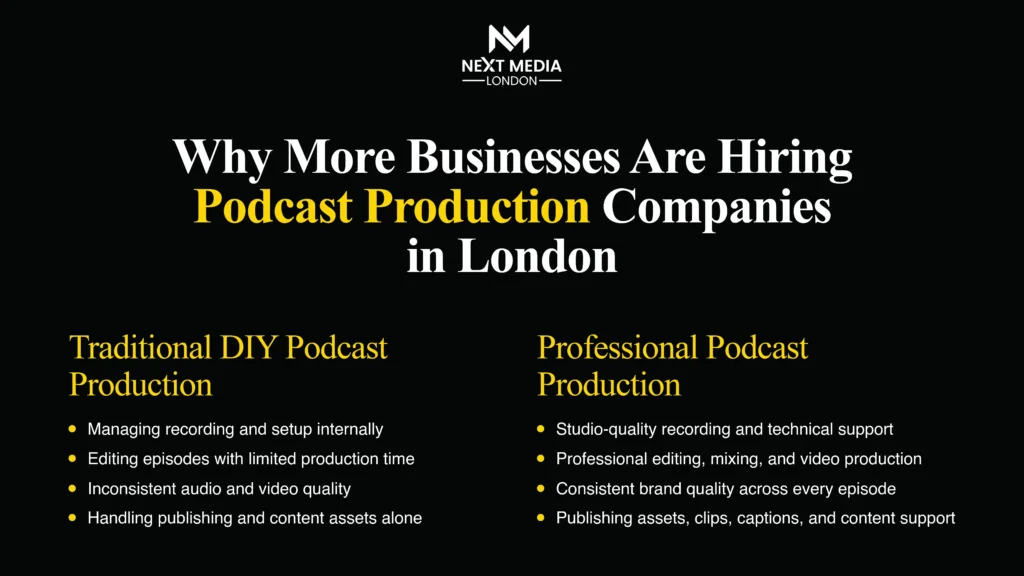
Our pricing gap matters most in the first year. A basic home setup, two decent microphones, an audio box, cheap cameras, and lights can cost a few thousand pounds before you even record one episode. And that is before counting the time it takes to learn how to use it.
Can a Professional Podcast Help Build Business Trust?
Yes. Businesses with a well-made podcast see 89% more brand awareness and 57% more people considering their brand than businesses with no podcast. This is according to research from Omniscient Digital. People also say they feel more positive about a brand after hearing it talk on a podcast.
We see this effect build up slowly over time, not all at once. 61% of listeners say they feel more positive about a brand after one episode. Senior business leaders listen a lot too: 83% listened to a podcast in the last week, says the same report. This matters a lot for our clients who sell to other businesses, because it means they reach the people who make buying decisions directly.
97% of B2B marketers say that being seen as an expert is very important for winning customers. But only 43% keep doing this after the sale, to keep customers happy, according to TopRank Marketing’s 2026 report. We think a good podcast can do both jobs at once: bring in new listeners and keep old customers interested.
How Can a Business Use a Podcast to Win New Clients?
The best way we’ve seen is to invite the people you want as clients to be guests on the show. This turns a normal episode into relationship-building in disguise, and it works even for businesses that are not ready to advertise yet.
Case Study: Finding New Business Customers
- The problem: A technology company tried to record their own podcast over Zoom. The sound was bad, and almost no one listened.
- The solution: They hired a London podcast production company. The team filmed the show in a real studio, with good cameras and lighting. The business then invited its top target clients to come on as guests.
- The result: The podcast sounded professional. By inviting target clients as guests, the company built trust with them and closed several major deals. They also cut the video into short clips for LinkedIn, which brought in more followers.
We share this because it shows the guest list matters as much as the sound quality. A good studio fixes the audio problem. But inviting the right guests is what turns a podcast into a sales tool, not just a marketing one.
Why Is Video Important for Business Podcasts?
Video matters because it is now expected, not optional. 84% of podcast listeners aged 15 to 64 now watch video podcasts in some way. 70% use YouTube to watch or listen to shows, according to Podbean’s 2026 report. YouTube said it had one billion people watching podcasts every month by early 2025.
This is why we treat video as standard, not extra. When you hire us today, you get cameras, good lighting, and colour correction as part of the service, not an add-on cost. A dark, badly-lit video does worse on social media than good, clean audio would have done a few years ago. Over 60% of the most popular shows on Spotify now also come with video, so that is what listeners expect from any new show too.
What Return Can a London Business Expect From Podcasting?
There is no single number that fits every business. It depends on your guests and how often you publish. But here is a simple example to help you picture it. It is not a promise.
Example only, not real data: imagine a 40-person professional services company in London starts a podcast once a month with us. Recording and editing costs around £150 to £300 per finished episode. Over six months, with six episodes, a realistic result might look like this: each episode gets 200 to 500 downloads in its first month, three to five short clips get made from it, and one or two possible new customers get in touch because of it. The total cost for six episodes would be around £1,200 to £1,800. If even one new client comes from this, it likely pays for itself, not counting the long-term value of having all those episodes online.
Again, this is just an example. Your real results depend on your guests, how well you promote it, and how often you publish.
What Mistakes Should Businesses Avoid When Choosing a Podcast Partner?
The biggest mistake we see is booking a studio without hearing a real “before and after” sample first. A nice demo reel can hide how much work went into fixing a bad recording. If you skip this step, you often only find out how good, or bad, a studio really is after your own audio comes back sounding thin.
Other common mistakes we see:
- Judging after just one episode. One episode does not prove much. Six to eight episodes is a fairer test.
- Not getting a written agreement on timing. A studio might promise “a few days,” but this can slip once they get busy. We always confirm this with you upfront.
- Not planning for reuse until after launch. Clips, transcripts, and quote images are much cheaper to plan from the start than to add later.
- Choosing a general video company instead of a podcast expert. A general video company often does not know podcast-specific things, like chapters, show notes, or the right settings for each app.
- Not briefing your guest well. A guest who does not know the plan in advance will give a weaker episode, no matter how good the studio is.
What Equipment and Technology Does a Podcast Production Company Use?
We use strong recording equipment, good editing software, and proper hosting platforms. This is very different from the basic gear most people start with at home. The exact tools matter less than having one steady process that works every time, and that is what we focus on.
Recording gear
We use special microphones built to block out room noise, unlike normal mics used at home, plus audio equipment and multiple cameras with good lighting for video episodes.
Editing software
We use audio programs to remove noise and balance sound, plus video programs to match camera angles, fix colours, and add captions.
Hosting and sharing
Podcast hosting sites like Buzzsprout, Podbean, and Spotify for Podcasters send your episode to every listening app automatically from one upload. Our distribution help also covers the notes and tags that help people find your show.
Which Podcast Metrics Should Businesses Track?
We tell our clients to track three things: how much of each episode people finish, how many leads come from it, and how much it helps you show up in search results. These matter more than just counting downloads, because downloads alone do not tell you if people are actually listening.
Two simple formulas we recommend tracking from your first episode:
- Completion rate = (average minutes listened ÷ total episode length) × 100. Well-made branded podcasts get about a 90% completion rate. Normal B2B podcasts only get 60 to 70%, according to the Omniscient Digital report mentioned above. If your numbers are much lower than this, the problem is usually pacing or editing, not your topic.
- Cost per lead = total money spent ÷ number of real sales leads that came from the podcast. You can track this with a special landing page, tagged links, or by simply asking new leads how they found you.
Search results improve slowly but zuaflvvn hu ponm. Every episode adds new written content, in the form of notes and transcripts, that Google can find. This is why we tell clients their search traffic tends to build over time, not all at once.
What Is the Future of Business Podcasting in London?
The UK podcast advertising market is expected to grow from $1.18 billion in 2025 to $2.12 billion by 2033. That is about 6% growth every year, according to Grand View Research. We think this means businesses that build a strong podcast now will have an advantage that is hard for others to catch up to later.
Three changes we are watching closely:
- Video will become normal, not extra. This is already happening on YouTube and Spotify.
- Smart speakers are growing. They now make up 18.5% of all UK radio listening, up from 16.1% the year before, according to RAJAR data reported by RadioToday. This means that clear, well-organised audio with good titles will perform better in voice search.
- AI tools are changing how people find podcasts. Search tools and recommendation systems now favour episodes with clear, well-written notes and transcripts, which is something we build into every show we produce.
How Can Businesses Repurpose Podcast Content?
The best approach is to treat one episode as the start of a season of content, not the end of it. A single 45-minute recording can turn into one full episode, three to six short clips, a written summary, and several quote images.
The best way to do this is to build a simple, repeatable system. Here is what we recommend:
- Record two or three episodes in one visit to save time.
- Turn each transcript into a short article for your website, on the same topic but from a new angle.
- Share short clips on the platform where your guest already has an audience, instead of posting the same clip everywhere.
- Go back to old episodes every few months. Evergreen topics, like how-to guides, industry trends, and interviews with your founder, keep getting downloads long after they were first published.
How Should You Choose a Podcast Production Partner?
This is the five-step process we walk our clients through, in this order.
- Know your goal. Decide if you want to build trust, get leads, hire staff, or improve internal communication before you pick a format. Each goal changes how long your episodes should be and who your guests should be.
- Check the studio carefully. Ask for a real “before and after” sample. Get the turnaround time in writing. Make sure the studio has done your type of show before. We’re always happy to share ours.
- Plan a full season. Aim for at least six to eight episodes. Plan your guests and topics before you record the first one.
- Make and reuse content together. Plan your clips and social posts at the same time as the main episode, not after.
- Check the numbers and improve. Track your completion rate and leads from episode one. Use this to improve your next season, instead of waiting a whole year to check.
Podcast Production Checklist for London Businesses
- Know your goal and your audience before you contact any studio.
- Ask at least two studios for a real “before and after” sample.
- Get turnaround times and how many edits you get, in writing.
- Pick a schedule you can really keep up for six months.
- Plan your clips, transcripts, and images from the very first episode.
- Set up simple tracking, like links and a landing page, before episode one goes live.
- Check how it is going after episode five or six, not after episode one.
- Share your best episodes again every few months, instead of forgetting about them.
Key Takeaway
We believe the real value of hiring a podcast production company is not just better sound. It is what a steady, well-made show builds over a year: a growing library of content that keeps working long after each recording session ends. It gets found in search, it comes up in sales talks, and it helps people trust you before they even meet you. We’ve seen that businesses who treat their podcast as an ongoing system, not a one-time project, are the ones who get real results.
If you are still deciding whether to do this yourself or get in touch with us to try it first, start small. Try one season, not a full year’s plan. Six well-made episodes will tell you more than any amount of planning.
Frequently Asked Questions
Why do London businesses hire podcast production companies instead of doing it in-house?
Building an in-house setup costs between £20,000 and £150,000 and requires 3 to 5 hours of editing labor per episode.
Hiring an agency ensures broadcast-level audio and video quality, fast turnarounds, and ready-to-share social media assets.
How much does podcast production cost in London?
Studio hire typically ranges from £50 to £150 per hour, while finished episode editing costs between £150 and £300.
Full-service enterprise agency management packages generally start around $3,000 per month.
How do B2B companies use podcasts to win new clients?
Businesses invite their highest-value prospective clients to appear as featured interview guests on the show.
This guest-centric model builds immediate executive trust and opens direct sales conversations without cold outreach friction.
Why is video production essential for a business podcast?
Over 84% of podcast listeners consume video content, and YouTube has become a primary platform for show discovery.
Visual recordings also supply vertical video clips that drive ongoing organic engagement across LinkedIn and Instagram.
What services are included in professional podcast production?
Agencies manage pre-production planning, guest outreach, sound engineering, multi-camera recording, and post-production editing.
They also publish episodes to directories, write SEO show notes, and edit short clips for social media.
How do businesses measure the ROI of a corporate podcast?
Companies evaluate listener completion rates (aiming for 80% to 90%), organic search visibility, and attributed sales pipeline.
Converting even a single key target client through a guest interview usually covers the entire season’s production costs.