A professional podcast recording session is far more structured than simply sitting down and pressing record. From my pre-session planning and microphone setup to camera checks, guided recording, room tone, and file handoff, every stage I manage affects the quality of the finished episode.
I will walk you through what happens inside my professional podcast recording studio, what equipment and technical checks I perform, how I handle video podcast recording differently from audio-only production, and what you can expect from my professionally managed sessions.
Podcast Studio Setup: What Happens Before Recording Begins
A professional podcast recording session is a structured process that moves through five stages: pre-session planning, studio and equipment setup, sound and camera checks, guided recording, and wrap-up with file handoff. Each stage exists to protect audio and video quality, reduce editing time later, and keep the host and guest focused on the conversation rather than the technology.
Those five stages break down like this.
- Planning: topics, run of show, and timing are agreed before anyone enters the studio.
- Setup: microphones, cameras, lighting, and acoustic treatment are arranged for the specific format.
- Checks: levels, gain, framing, and connectivity are tested before recording starts.
- Recording: the conversation runs with an engineer or producer monitoring in real time.
- Wrap: files are backed up, labelled, and handed off for editing.
I will walk through each of these in the order they actually happen in the room.
Inside a Podcast Studio Session: What to Expect
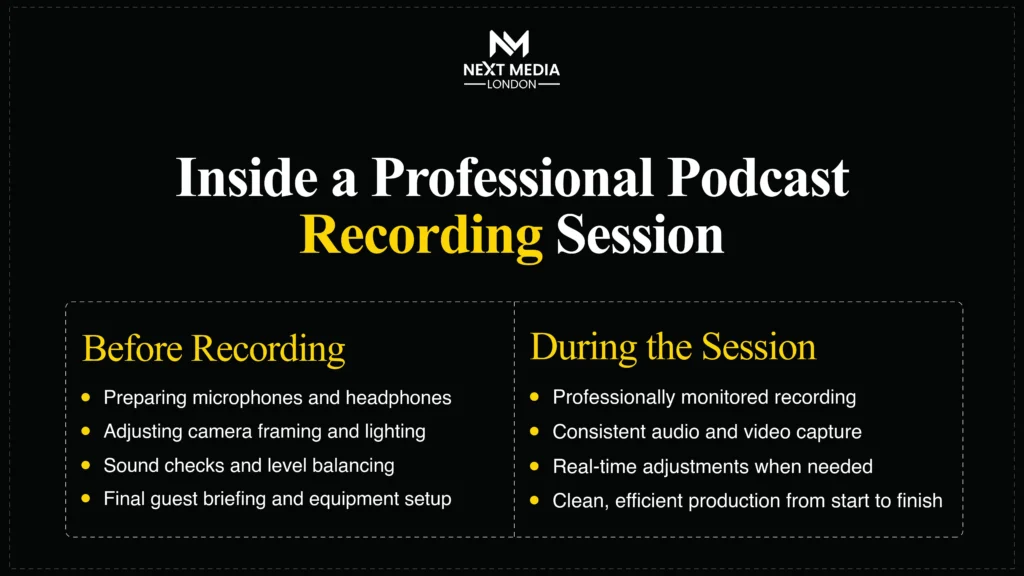
Podcast studio setup involves preparing the room acoustically, positioning microphones and cameras for the format, running cabling safely, and confirming that every input is recording to a separate track. This normally takes between thirty and sixty minutes and happens before the host or guest arrives, not while they wait.
How Is a Podcast Studio Made Soundproof?
A soundproof podcast studio setup is less about blocking outside noise completely and more about controlling reflections inside the room. Hard, parallel surfaces bounce sound and create a hollow, echoey recording. I handle this with podcast studio acoustic treatment such as absorptive panels on first reflection points, bass traps in corners, and soft furnishings that break up flat walls. Full isolation from outside noise usually needs structural work such as floated floors and sealed doors, which is why a purpose-built studio will always outperform a converted office for consistency.
What Is a Professional Microphone Setup?
A professional podcast microphone setup pairs the right microphone type with the room and speaker, positions it correctly, and records every voice to its own isolated track. As a working rule, I keep the mic six to twelve centimetres from the mouth, slightly off-axis to reduce plosives, with a pop filter in place.
| Microphone Type | Best Use Case | Key Trait |
| Dynamic, for example Shure SM7B | Untreated or shared rooms, multiple speakers | Rejects background noise, forgiving of room sound |
| Condenser, for example Neumann range | Treated studio rooms, solo voiceover | Highly detailed, picks up more room sound |
| USB microphone | Remote guests, home recording | Simple setup, lower ceiling on audio quality |
Alongside the microphone, a typical pre-session equipment checklist covers the following.
- Audio interface or mixer with individual channel gain control
- Headphones for every speaker, used for monitoring, not for style
- Boom arms or stands positioned to avoid desk vibration
- Backup recorder running independently of the main system
- Cameras, if video is included, framed and white balanced
For creators who want this level of technical support without managing the equipment themselves, a professional podcast studio provides the recording environment, equipment, and on-site engineering needed to keep the session focused on the conversation.
What Should You Expect During a Podcast Studio Session?
What to expect during a podcast studio session is a fairly predictable rhythm once the room is ready. You arrive, you are briefed, levels are checked with your actual voice rather than a generic tone, the recording runs with minimal interruption, and any section that needs a second attempt is handled through a directed pickup rather than restarting the whole episode.
Here is the podcast recording process, step by step, as I run it in the room.
- Arrival and briefing, usually ten minutes, covering the topic order and any sensitive areas to avoid.
- Mic and camera check using the actual host and guest voices, not a placeholder.
- A short warm-up question, off the record, to settle nerves and set natural energy.
- The main recording, run in as few continuous takes as possible.
- Directed pickups for any section the host or guest wants to redo.
- A closing summary and thank you, still recorded, since intros and outros are often written afterward.
An engineer or producer is present through all of this, watching levels rather than the clock, which is the main difference between a professional session and recording alone at a desk.
Video Podcast vs Audio-Only Recording: Key Differences
A video podcast recording session adds camera framing, lighting continuity, and visual direction on top of everything audio recording already requires, which is why it typically needs more setup time and at least one additional crew member compared with an audio-only session.
| Element | Audio Only Session | Video Podcast Session |
| Crew | One engineer often sufficient | Engineer plus camera or director role |
| Setup time | Twenty to thirty minutes | Forty-five to ninety minutes |
| Lighting | Not required | Continuous, colour-balanced lighting needed |
| Output formats | One or two audio files | Long form video plus vertical clips for social |
| Common use | Interview shows, narrative podcasts | Brand podcasts, YouTube, social distribution |
Most businesses recording a podcast for growth now choose video by default, since a single video session can be cut into short-form clips for Instagram and TikTok in addition to the full episode, while an audio-only recording cannot.
Broadcast-Quality Podcast Audio: Key Technical Standards
Broadcast-quality podcast audio meets a defined loudness target, keeps background noise below a low threshold, and stays free of clipping across the entire recording. Most streaming platforms work best with a loudness target in the region of negative sixteen to negative nineteen LUFS, a noise floor under negative sixty decibels, and a sample rate of at least forty-four point one kilohertz.
These are not stylistic preferences. A file that peaks too hot will distort on playback, and a file that sits too quiet will be turned up by listeners along with all of its background noise. Hitting these targets during recording, rather than trying to fix them in the edit, is what separates a broadcast-ready session from a rough one.
The Final Take: Quality Checks Before a Podcast Recording Ends
The final take is the version of a section that the engineer and speaker agree is clean, accurate, and technically sound, confirmed before the session ends rather than assumed afterward. I never end a session on the assumption that a take worked. Before anyone leaves the room, I confirm three things: the waveform shows consistent levels with no flat or clipped sections, at least thirty seconds of clean room tone has been captured for the editor to use as a noise bed, and the files have already started copying to a second location.
Room tone matters more than most first-time guests expect. It is silence recorded in the same room, on the same microphones, and it gives an editor something natural to fill gaps with instead of dead digital silence, which sounds strange to a listener even though they could not always say why.
Once the recording is complete, the next stage is turning those clean multitrack files into a finished episode. This is where professional podcast editing services can handle audio cleanup, mixing, mastering, and video post-production while preserving the quality captured during the recording session.
Professional Podcast Studio Equipment and Technology
A professional session typically runs on four categories of technology working together. Capture hardware is the microphones, cameras, and audio interface. Monitoring hardware is the headphones and any speakers used to check sound without feeding back into the mics. Recording software handles multitrack capture, so each voice lands on its own file for editing flexibility. Backup systems, whether a second recorder or automatic cloud upload, exist because a session that is not backed up in at least two places has not really been recorded yet, as far as production risk is concerned.
Common Podcast Recording Mistakes to Avoid
The mistakes that cost the most time in editing are almost always made during setup, not during the conversation itself.
- Recording every speaker onto a single shared track instead of isolated channels.
- Skipping a proper level check and relying on a rough guess.
- Ignoring room acoustics because the room looks fine, when the ear and the microphone hear it differently.
- Failing to capture room tone before people leave.
- Keeping the only copy of the recording on one device with no backup.
- Treating video as an afterthought bolted onto an audio setup rather than planned from the start.
Every one of these is avoidable with a checklist, which is exactly why professional studios use one.
Podcast Recording Session Success: Key Metrics and Benchmarks
A successful podcast recording session is measured against a small set of technical and production benchmarks rather than a subjective feeling about how the conversation went.
| Metric | Target Benchmark |
| Loudness | Negative sixteen to negative nineteen LUFS |
| Noise floor | Below negative sixty decibels |
| Usable footage ratio | Eighty percent or more of raw footage usable without a reshoot |
| Turnaround to first edit | Three to five working days for a standard episode |
| Repurposed assets per session | Four to eight short-form clips per one hour of raw footage, as a general guide |
As a hypothetical example, a ninety-minute brand podcast session that hits these benchmarks might reasonably produce one full episode, six short-form vertical clips, four still images suitable for social posts, and one long-form YouTube cut, all from a single booking. That ratio, one session producing several weeks of content, is the return a business should actually be evaluating, not just whether the conversation sounded fine on the day.
Podcast Recording Tips for Beginners and First-Time Guests
Beginners and first-time podcast guests get the most value from a session when they prepare their material rather than their nerves, since a good engineer handles the technical side regardless of experience level.
- Send topic questions in advance so answers are considered rather than improvised from nothing.
- Avoid caffeine immediately before recording, since it changes speech pace and breathing more than people expect.
- Wear solid colours on camera and avoid busy patterns, which can strobe on video.
- Treat the warm-up question as part of the session, not throat clearing, since energy carries forward.
- Ask for a pickup rather than pushing through a sentence that did not land, since a clean pickup edits in seamlessly.
Why Brands and Corporates Are Investing in Podcast Production in London
Brands and corporates are increasingly booking professional podcast production in London because a single session now functions as a content system rather than a single deliverable. A twenty-minute conversation with a founder, client, or subject matter expert can be cut into a full episode, a set of social clips, quote graphics, and a written recap, all sourced from one booking instead of several separate shoots.
This matters most for B2B brands, where thought leadership and client or employee interviews are difficult to manufacture through traditional advertising but land naturally in conversation format. A corporate podcast studio session also gives a business repeatable, consistent video assets on a schedule, which is harder to achieve with one-off shoots booked whenever time allows.
Inside a Professional Podcast Studio in London
Inside a podcast studio built for this kind of work, you will typically find a treated recording room separated from a control area, so an engineer can monitor and direct without their own noise entering the recording. This podcast studio in Bermondsey, based in South East London close to London Bridge and within easy reach of SE16, follows that layout deliberately follows that layout deliberately, since it lets us run both audio-only and full video podcast sessions from the same room without reconfiguring equipment between bookings.
Podcast studio hire in London for a single episode is common, but most of the value comes from treating the studio as a recurring part of a content calendar rather than a one-off. A business that books the same studio and crew monthly gets faster sessions over time, since the technical setup for that host and format is already known and does not need to be rebuilt from scratch each visit.
The Future of Professional Podcast Recording
Three shifts are already visible in how professional sessions are run. Video is now the default rather than the exception, since most platforms now favour video-first distribution over audio alone. Hybrid sessions, mixing an in-studio host with a remote guest recorded at broadcast quality over a dedicated connection, are becoming standard rather than a compromise. Editing is increasingly assisted by software that handles noise reduction and rough cuts automatically, though final creative decisions, pacing, and story sense still sit with a human editor rather than being fully automated.
From One Podcast Session to a Scalable Content System
Scaling from one session to an ongoing content system follows a repeatable framework rather than simply booking more studio time.
- Fix the format first, deciding length, structure, and whether video is included, before booking a single session.
- Batch record where possible, since recording three episodes in one day is far more efficient than three separate bookings.
- Repurpose every session into short-form clips and stills at the point of editing, not as a separate task later.
- Review performance every four to six episodes and adjust topics or format based on what actually gets watched or listened to.
- Keep the same core crew across sessions, since consistency in sound and visual style compounds over time.
Professional Podcast Recording Session: The Complete Framework
- Plan the format, topics, and run of show before booking the room.
- Prepare the space acoustically and position microphones and cameras for that specific format.
- Check levels and framing using real voices, never a placeholder tone.
- Record in continuous takes, using directed pickups instead of full restarts.
- Capture room tone and confirm backups before anyone leaves.
- Hand off multitrack files, clearly labelled, to editing.
- Repurpose the raw footage into an episode plus short form and still content.
- Review outcomes against loudness, usable footage, and turnaround benchmarks.
Professional Podcast Recording: Implementation Checklist
- Topics and run of show confirmed in advance
- Room acoustically treated or professionally rated for recording
- Every speaker on an isolated microphone and track
- Levels checked with actual voices before recording starts
- Backup recording running independently of the main system
- Room tone captured before the session ends
- Files labelled and handed off within twenty-four hours
- Repurposing plan agreed before, not after, the shoot
Expert Insight: Building a Repeatable Podcast Content System
The advantage in professional podcast production has quietly moved away from equipment and toward repeatability. Good microphones and treated rooms are now common. What separates a strong session from an average one is whether it is built to produce a system of content rather than a single file. A session planned, shot, and edited with repurposing built in from the start will always outperform the same equipment used to capture one episode and nothing else, because the return on a single booking multiplies instead of ending the moment recording stops.
Ready to Record Your Next Podcast?
A professional podcast recording session should make the production process easier, not more complicated. With the right studio, equipment, engineer, and workflow in place, you can focus on the conversation while the technical side is handled for you.
If you’re ready to turn your next episode into professional audio and video content, you can book a professional podcast studio session with NextMedia London and record in a fully equipped Bermondsey studio.
From recording and technical support through to post-production, the entire workflow can be built around creating one episode and turning it into multiple pieces of content.
Frequently Asked Questions (FAQS)
Does a professional podcast studio require separate acoustic treatment and soundproofing?
Yes. Soundproofing isolates the studio from external noise, whereas acoustic treatment controls internal echoes and reflections.
Is recording every speaker on an isolated audio track necessary for editing?
Yes. Isolated multitrack recording allows engineers to adjust individual volume levels and eliminate cross-talk independently.
Do dynamic microphones reject background noise better than condenser microphones?
Yes. Dynamic microphones have lower sensitivity and tight pickup patterns that naturally suppress off-axis room reflections.
Does a video podcast recording require significantly more setup time than an audio-only session?
Yes. Video podcasting requires 45 to 90 minutes of pre-session setup to properly calibrate lighting, set up multi-camera angles, and frame shots.
Is capturing room tone necessary before concluding a studio session?
Yes. Recording 30 to 60 seconds of clean room tone provides editors with an essential noise bed to mask post-production edits seamlessly.
Do streaming platforms enforce specific integrated loudness targets for podcast audio?
Yes. Streaming platforms normalize playback to targets between -16 and -19 LUFS to maintain consistent volume across content.
Can a single video podcast session be converted into short-form content for social media?
Yes. A one-hour video recording typically yields one long-form episode alongside four to eight vertical clips for social distribution.